
Intentional Solitude: The Secret to Community Stamina and Beating Burnout


We live in a culture that fundamentally misunderstands the architecture of human connection. We operate under the naive assumption that preventing burnout and emotional exhaustion is simply a matter of expanding our social circles—more meetings, more surface-level check-ins, more frantic networking. We treat the desire to step away from the crowd as a dangerous warning sign, a slide into isolation, or a selfish retreat from communal responsibility. But to protect our endurance, we must understand that practicing intentional solitude is not an act of abandonment; it is the exact structural discipline that preserves our capacity to serve others over the long haul.
The Illusion of the Crowded Core
This diagnostic error directly ignores the biblical reality of service. While we often view intentional solitude as a luxury—a task reserved only for the well-off—the Apostle Paul anchors our endurance in a deep-seated spiritual principle: "...for whatever a man sows, that he will also reap" (Galatians 6:7).
If we exclusively sow our limited time and energy into the frantic demands of the crowd, not connecting our motives to Christ, we will inevitably reap systemic exhaustion. Recognizing this exact trap, Paul explicitly warns believers against the dangerous dynamic of overextending ourselves:
"Let us not become weary in doing good, for at the proper time we will reap a harvest if we do not give up" (Galatians 6:9).
The immediate, conventional take on this passage usually limits its scope to our outward moral or ethical choices. Yet, we routinely overlook the deeper, evergreen warning: we cannot fight a spiritual and psychological weariness by injecting more external noise into our lives. True intentional solitude requires an anchoring of the soul that the things of the world simply cannot provide.
When you look at the landscape of high-stakes leadership and community care through an empirical lens, a startling paradox emerges: the individuals who love their communities the most are often the ones who leave them the most frequently. To sustain long-term passion for people without losing your soul, you must dismantle the myth of being the Lone Ranger. Intentional solitude requires deep soul care roots, and these roots are only grown when the audience is completely gone. If you want to survive the relentless demands of serving others, you must learn that pulling back does not destroy your capacity for community—it is the exact discipline that preserves it.
The Landscape of the Valley: A View From the Desert Floor

To speak clearly about the necessity of pulling back, we must first look at how we behave when the terrain gets steep. Anyone who has ever attempted to traverse a high-desert mountain trail, or bike that impossible road, knows that stamina is not a byproduct of frantic pacing. In my own life—whether navigating the high-intensity environment of a critical care hospital ward as a chaplain or looking out over across Fort Jackson's physical training field, waiting to compete in the bi-anual army physcial fitness test (AFT)—I have learned that endurance, in grief or in physical stamina, is determined, not by how much of a load you can lift, but by what you carry internally, in the soul, when the landscape goes entirely silent.
When you are out on an exposed ridgeline, in the mountain air, far above the tree line where the wind shears away all non-essential noise, there is no crowd to perform for. There are no titles, no superficial check-ins, and no immediate feedback loops to sustain your momentum. If a crisis or a sudden exhaustion hits you out there, you are instantly stripped down to the raw material of your true identity. You find out exactly what is anchoring you when the external scaffolding falls away.
In our normal, daily routines, we treat public busyness as a badge of honor, running ourselves ragged under the guise of community devotion. But running on empty across a barren stretch of life isn't grit; it is a fast track to structural collapse. True psychological and spiritual grit does not mean running blindly until you drop. It means having the internal stamina to stop, step back from the crowd, and sit in the quiet long enough to let your primary motivations be thoroughly recalibrated.
The Empirical Necessity of Intentional Solitude
This psychological endurance is not a luxury for the detached philosopher; it is a functional requirement for anyone operating within heavy leadership or caregiving structures. While prolonged, involuntary isolation can rapidly erode mental health, structured, self-directed periods of quiet act as an indispensable firewall against systemic collapse.
In her comprehensive, data-driven research regarding modern connection, behavioral scientist Susan Mettes exposes a vital distinction in how resilient individuals protect their internal energy reserves. Writing in The Loneliness Epidemic, she notes that the leaders most insulated from catastrophic exhaustion are not those with the largest outward networks, but those who fiercely protect a private boundary for internal evaluation:
"To protect yourself from the exhaustion of a demanding public life, you must establish an inner room... Those who cannot endure the silence of their own company will inevitably find that their public utility collapses under the weight of an unexamined heart" (Mettes 112).
Mettes' findings provide a powerful empirical anchor for this practice, but they also create a compelling psychological tension. While our instincts drive us to use social noise as an anesthetic to escape our inner lives, the data proves that failing to brave that quiet leaves us uniquely vulnerable to chronic, systemic exhaustion. We trap ourselves in a lethal loop: we run to the crowd to escape our internal restlessness, but escaping into the crowd systematically drains the very stamina we need to care for them.
Anatomy of Internal Stamina: Duckworth's Grit Framework

To understand how a person survives this tension, we must cross-reference this empirical data with modern motivation theory. In her seminal research on human performance, psychologist Angela Duckworth defines grit as "perseverance and passion for long-term goals" (Duckworth 92). It is the psychological engine that allows an individual to sustain intense effort over years, even when faced with failure, stagnation, or systemic drag.
However, when we map Duckworth's grit framework onto the interior life, we discover a profound truth: sustaining long-term passion for a community requires deep, undisturbed roots. You cannot maintain an elite level of outward perseverance if your internal baseline is constantly fluctuating based on the opinions, demands, or validation of the crowd.
[ Outward Perseverance] --> Requires --> [ Deep Interior Baseline ]
                                                   |
                                            Starved & Recalibrated
                                                   |
                                                   v
                                        [ Intentional Solitude ]
Entering this space requires a specialized sub-category of endurance: the Grit of Quiet. In the initial stages of pulling back, the brain undergoes an acute form of cognitive friction. Stripped of the predictable dopamine hits provided by notifications, social media feeds, and casual praise, the mind rebels. It generates a sudden wave of restlessness, anxiety, and a frantic impulse to return to a state of distraction.
If an individual lacks the internal stamina to stay in the chair during this withdrawal phase, they will inevitably retreat back to the noise. They confuse the temporary discomfort of internal recalibration with actual loneliness. True grit means enduring this initial psychological friction until the false self starves, allowing your primary drive to stand firmly on its own feet.
Generative Solitude vs. Destructive Loneliness
To navigate this territory successfully, you must learn to distinguish between the toxic vacuum of isolation and the protective ecosystem of the quiet. Renowned social psychologist Dr. David G. Myers, a foundational voice on the science of subjective well-being, notes that our culture's record-high rates of isolation have caused us to misdiagnose the nature of quiet. In analyzing our frayed social architecture, Myers notes:
"Aloneness need not entail loneliness... we live longer, as well as more happily, when supported by close, caring relationships, [but] social isolation and loneliness are known to impact health via the biology of stress" (Myers, "Loneliness Epidemic").
The bridge across this daunting chasm is a targeted deployment of internal stamina. They may look identical from the outside—both involve a closed door and a silent room—but their psychological markers are worlds apart.
Psychological Marker | Destructive Loneliness | Generative Solitude |
Volitional Origin | Involuntary deprivation; forced upon the individual by circumstance or social rejection. | Deliberate choice; a proactive boundary enacted to suspend social intake. |
Internal Focus | A painful awareness of lack; an agonizing fixation on what is missing from the outside world. | An intentional focus on presence; a rigorous evaluation of the internal landscape. |
Ego Mechanics | The false self panics, starves for validation, and enters a state of defensive paralysis. | The false self is systematically starved, allowing the authentic identity to anchor itself. |
Communal Impact | Fosters resentment, emotional withdrawal, and an eventual fracture from leadership roles. | Recalibrates internal motivation, restoring the emotional reserves required for deep care. |
The Relational Exhaustion of the Counterfeit Core

When we ignore this distinction, we begin to use other people as commodities to fuel our personal sense of worth. In his profound exploration of human relationships and spiritual formation, Dr. Larry Crabb analyzed this precise behavioral trap. In his book, Inside Out, Crabb observed that human beings routinely choose the shallow comfort of a frantic lifestyle over the terrifying reality of internal evaluation:
"We would rather protect ourselves from the pain of facing our deep thirsts by keeping busy with superficial satisfactions" (Crabb 33).
When you use the crowd as a "superficial satisfaction" to numb your inner anxieties, your relationships become transactional. You aren't actually loving the community; you are consuming the community's validation to keep your own hollow core from collapsing.
This is why the idea of a lone ranger is so destructive. The individual who refuses to step away because they are "too needed" is often the person most terrified of what they will find when the room falls silent. It takes immense psychological grit to cut off those superficial satisfactions, endure the immediate emotional withdrawal, and face the deep thirsts that a frantic lifestyle successfully hides.
Prison of Self-Absorption: C.S. Lewis the Hall of Noises
This defensive retreat into external noise doesn't just exhaust our energy—it completely distorts our perception of reality. In his classic satirical work The Screwtape Letters, C.S. Lewis masterfully exposes how the forces of distraction deliberately use a relentless barrage of input to prevent a person from achieving true self-examination.
Writing from the perspective of Screwtape, a senior demon instructing his nephew, a junior demon, on how to systematically destroy a human soul, Lewis frames the engineered elimination of quiet as the ultimate weapon against the human spirit. Screwtape boasts of Hell's grand architecture with chilling precision:
"Music and silence—how I detest them both! [...] [Hell] has been occupied by Noise—Noise, the grand dynamism, the audible expression of all that is exultant, ruthless, and virile—Noise which alone defends us from silly qualms, despairing scruples and impossible desires. We will make the whole universe a noise in the end" (Lewis 102).
In the economy of the soul, the uncle's demonic strategy is brilliant: because God often speaks in the stillness, the spirit is refreshed in the quiet, therefore, the ultimate goal of a broken world is to transform our reality into an unceasing "Kingdom of Noise."
When we live in the "hall of noises," we become trapped in a prison of our own self-absorption. We cannot see our neighbor clearly, nor can we connect our motives to Christ, because we are too busy managing the external static required to keep our own fragile egos afloat. Practicing intentional solitude is the ultimate act of defiance against this kingdom—it is the choice to smash the shield of distraction and allow the air of silence to reveal the truth of our identity.
Stepping into quiet is the act of smashing that shield. By deliberately entering the silence, you refuse to let noise dictate the boundaries of your mind. You step out of the grand dynamism of the crowd, allowing the frantic performance narratives to die a natural death. It is an unblinking confrontation with the self, where you finally allow the air of silence to reveal the melody of your authentic identity.
Gospel of Withdrawal: Keller on Counterintuitive Rest
This discipline of pulling back is not a modern psychological invention; it is the exact blueprint modeled by Jesus throughout the Gospels. In his profound analysis of Christ’s public ministry, pastor and theologian Timothy Keller noted that Jesus’ recurrent retreats to "desolate places" were not accidental rest stops, but the very source of His public endurance. Reflecting on the mechanics of spiritual service, Keller observed:
"Jesus does not give us a model of unceasing, frantic activism. Over and over again, we see Him breaking away from the crowds—not when things were slow, but precisely when the demands were at their peak. He withdrew to the wilderness to pray, anchored in the Father’s love, so that He could return to the brokenness of humanity without being consumed by it" (Keller, Ministries of Mercy).
Keller’s insight completely upends our cultural concept of devotion. If the Son of God required these periods of withdrawal to sustain His earthly ministry, it is absolute arrogance for us to assume we can handle the systemic vulnerabilities of leadership and care without ever dropping our steering wheel.
[ Frantic Activism ] ---------> Leads to ---> [ Systemic Collapse ]

[ Christ's Withdrawal ] ----> Leads to ---> [ Public Endurance ]
When you step into the quiet, you are following an ancient, time-tested trail. You are declaring that the work of community care belongs fundamentally to God, not to your own frantic performance. You step back to realign your heart with the ultimate source of internal stamina, ensuring that your public utility is fueled by an unshakeable security rather than a desperate need for human approval.
When the Feedback Stops: Anchoring the Grit of Quiet
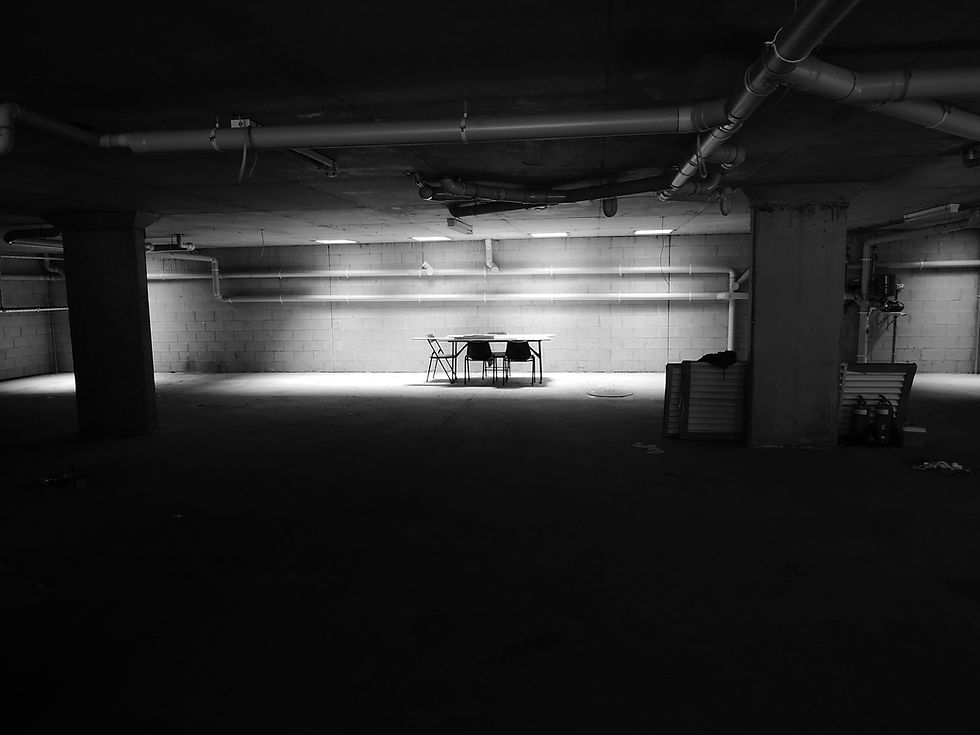
When you apply long-term perseverance to the empty space, you stop treating quiet as a passive void where loneliness festers. Instead, you master the Grit of Quiet, transforming the stillness into a robust internal ecosystem.
As Myers demonstrates in his extensive research on The Funds, Friends, and Faith of Happy People, a healthy identity requires a deep interior baseline. Without that baseline, our public service becomes a vicious circle of negative feedback loops. If we do not break that circle by stepping back, we fall into what Myers describes as a "paralysis of the will, passive resignation, and even motionless apathy" (Myers, Social Psychology).
This is where secular grit transitions into spiritual surrender. By staying in the chair and refusing to engage the digital anesthetic or reach back toward the noise of public approval, you cut off the world's supply line. You prove to your own consciousness that your identity does not collapse when the applause stops or the credentials are stripped away.
You do not step away to abandon the crowd; you step into the quiet to disarm, to drop the weapons of impression management, and to allow your motivations to be thoroughly purified. Only when your soul is anchored in an unshakeable security—far beyond the reach of human expectation—can you step back into the chaos of community, completely equipped to endure the weight of care without losing your footing.
Cheers!
Justin
About the Author
The author holds a Ph.D. and is an ordained professional chaplain, specializing in the integration of motivation theory, psychological resilience, and pastoral soul care. Having transitioned from a ten-year active duty career as a Captain in the U.S. Army, serving within the high-intensity environment of a critical care hospital, to now a veteran and civilian, his work bridges empirical behavioral science with practical strategies for long-term identity formation. He serves as the primary researcher for grittygritgrit.com, a digital platform dedicated to helping individuals cultivate authentic perseverance through the profound transitions, traumas, and valleys of life. You can also find his work on deercreeklasal.com.
Works Cited
Crabb, Larry. Inside Out. NavPress, 1988.
Duckworth, Angela. Grit: The Power of Passion and Perseverance. Scribner, 2016.
Keller, Timothy. Ministries of Mercy: The Call of the Jericho Road. P&R Publishing, 1997.
Lewis, C.S. The Screwtape Letters. SCM Press, 1942.
Mettes, Susan. The Loneliness Epidemic: Why So Many of Us Feel Alone—and How
You Can Find Your Way Home. Brazos Press, 2021.
Myers, David G. "Loneliness Epidemic." TalkPsych, 2023.
Myers, David G. Social Psychology. 14th ed., McGraw Hill, 2022.


Comments